Radeon RX 9070 vs Radeon RX 7900 XTX
Couple months ago I bought Sapphire Pulse RX 9070 for my spare rig. Before installing it in the PC it was intended for I run some benchmarks comparing the card to my 7900 XTX in my main PC.
Test Setup
Disclaimer: Please keep in mind that I am not a professional reviewer nor I aspire to be one. Those are just the the tests I run for my own curiosity. Testing methodology is most likely flawed.
Hardware configuration:
- Ryzen 9 5950X
- ASRock X570 Taichi (BIOS 5.00 AGESA 1.2.0.7)
- GSkill F4-3200C14D-32GTZKW (2x16GB @ 3733MHz 16-16-16-32 1T GDM On)
- Plextor M5 Pro 256GB
- Noctua NH-D15S
- Seasonic Vertex GX-1000 1000W Gold
GPUs under test:
- PowerColor 7900XTX Red Devil @ 2525/2500 MHz (silent BIOS)
- Sapphire Pulse RX 9070 @ 2520/2518 MHz
Used software versions:
| Software | Version |
|---|---|
| Windows 11 | 25H2 (Memory integrity off) |
| AMD GPU drivers | 25.12.1 |
| AMD chipset drivers | 7.11.26.2142 |
| 3D Mark Time Spy | 1.2 |
| 3D Mark Speed Way | 1.1 |
| Cyberpunk 2077 | 2.31 |
| Shadow of the Tomb Raider | 1.0.1.1 GOG |
| Metro Exodus Enhanced | s04_black_smoke |
Tests Results
Keep in mind that while the RX 9070 I have used for this comparison runs with reference clocks as far as I know, used 7900 XTX (PowerColor Red Devil) by default uses slightly bumped clocks. This might influence the results a bit. I only benchmarked the cards in 2560x1440 resolution, partially because that is the resolution I use daily, partially because I think this is the standard those days. 3DMark tests were run using the default resolution for those benchmarks.
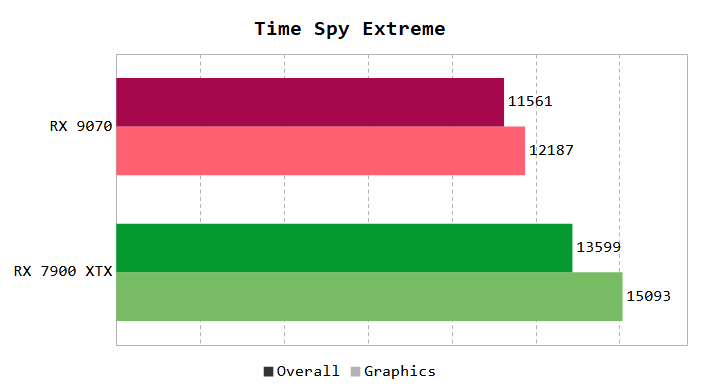

As expected RX 7900 XTX comes on top. Speed Way is supposed to use some ray tracing techniques according to its description 1.
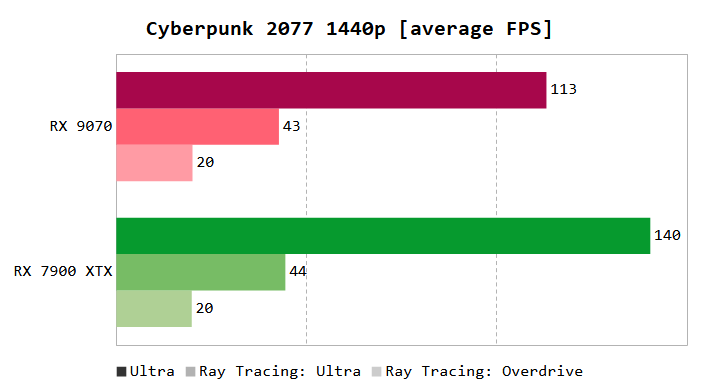
Settings used for Cyberpunk 2077 (integrated benchmark):
| Resolution | 2560x1440 |
| Quick Preset | Ultra/Ray Tracing: Ultra/Ray Tracing: Overdrive |
| Resolution Scaling | off |
RX 9070 catches up to 7900 XTX when ray tracing is enabled and even edges it out (by tenths of a frame) with path tracing on.
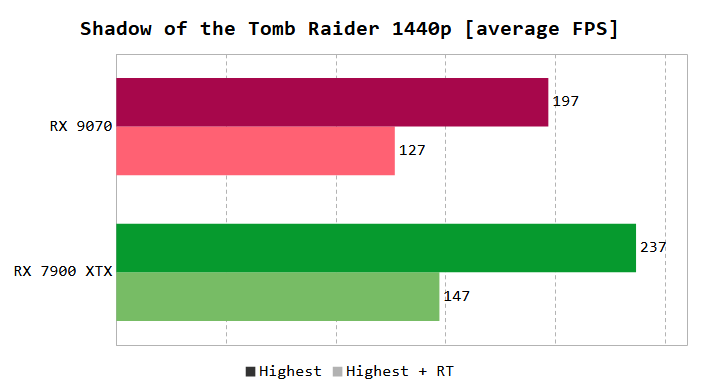
Settings used for Shadow of the Tomb Raider (integrated benchmark):
| Resolution | 2560x1440 |
| API | DirectX 12 |
| Vsync | Off |
| Anti-Aliasing | TAA |
| Preset | Highest |
| Ray Traced Shadow Quality | off/Ultra |

Settings used for Chernobylite (integrated benchmark, first scene only):
| Resolution | 2560x1440 |
| Graphics Quality | Ultra |
| VSync | No |
| Framerate Lock | unlimited |
| Ray Tracing | unavailable |
| AMD FSR 1.0 | off |
This game for some reason does not allow enabling Ray Tracing on AMD cards
Conclusion
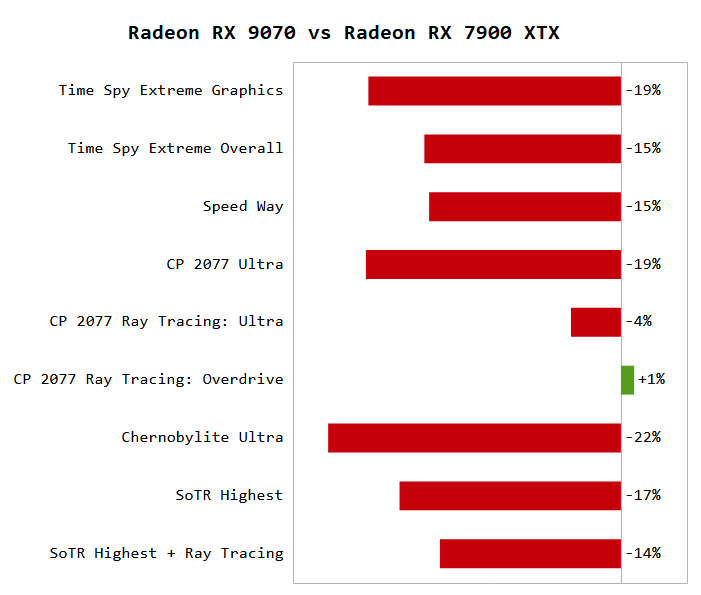
On average RX 9070 is ~18.3% slower in rasterization and ~11% slower in ray tracing (not including CP 2077 path tracing result) in 1440p. Considering I paid for the RX 9070 less than half of what I had paid for the 7900 XTX and the fact that RX 9070 uses significantly less power I would say that this is a fair trade-off.
Sapphire Pulse RX 9070 is sitting in my rig at my parents place for a few months now and I must say I am pretty happy with the card. Card is quiet and seems quite sturdy and actually pretty compact while still offering decent performance. I really wanted a power efficient card for that PC (that’s why I didn’t grab 9070 XT) and 9070 non-XT provided that.